 AJMNAssociated Journalism & Media Network
Edge vs. Cloud Computing: How Hybrid Architecture Is Transforming Data Processing
As digital systems scale across industries, data processing has become a decisive competitive factor in business infrastructure. Cloud computing has powered global-scale applications for more than a decade, but the rise...

As digital systems scale across industries, data processing has become a decisive competitive factor in business infrastructure. Cloud computing has powered global-scale applications for more than a decade, but the rise of real-time analytics, autonomous devices, and low-latency operations has introduced a new paradigm: edge computing. The next generation of computing will not abandon the cloud; it will strategically distribute intelligence between cloud platforms and local edge environments.
Why Cloud Computing Became the Backbone of Digital Infrastructure
Cloud computing enabled organizations to break free from physical servers, shifting storage and processing to hyperscale data centers operated by companies such as Amazon, Microsoft, Google, and Oracle. The model provides virtually unlimited scalability, elastic resources, and lower capital expenditure.
Centralized compute power allows companies to:
- Deploy global-scale applications.
- Analyze large datasets without owning hardware.
- Innovate faster through platform-as-a-service ecosystems.
- Secure operations through unified cloud monitoring.
Cloud platforms remain ideal for big data, enterprise analytics, AI model training, and services requiring global integration. Its limitation, however, lies in physical distance and network latency.
The Emergence of Edge Computing: Real-Time at the Source
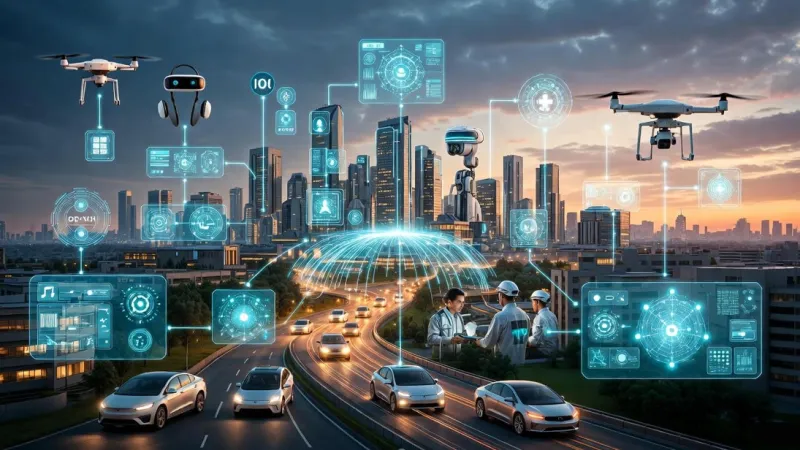
Edge computing processes data at or near the device generating it, rather than sending everything to the cloud. This shift is driven by applications requiring immediate response and continuous operation, where delays are unacceptable or bandwidth is limited. Examples include autonomous vehicles, smart manufacturing, robotics, remote industrial sites, predictive maintenance in oil fields, and medical devices monitoring patients in real time.
By minimizing round-trip transmission to distant data centers, edge computing:
- Reduces latency to near zero.
- Decreases bandwidth consumption.
- Ensures operations continue during network disruptions.
- Enables immediate local decision-making.
For businesses, edge computing delivers faster insights and safer autonomous actions.
The Strategic Relationship: Cloud for Intelligence, Edge for Action
The emerging architecture is not a competition, but a layered system. Edge devices execute rapid decisions locally, while the cloud aggregates wider intelligence, historical analysis, and cross-location data.
In the coming decade, operational technology (OT) and information technology (IT) will converge in hybrid infrastructure where:
- Edge handles real-time response and device-level computing.
- Cloud manages AI training, security, storage, and orchestration.
- AI models are trained centrally, then deployed to the edge.
This synchronization allows vehicles to navigate independently, robots to adapt to manufacturing changes, and retail analytics to respond instantly to customer movement.
Security, Regulation, and Distributed Risk Management
With billions of edge nodes anticipated by 2030, decentralized computing creates a broader attack surface. While cloud data centers centralize security controls, edge environments require distributed protection, including hardened devices, encryption at the source, and zero-trust architectures.
Industries with regulatory pressure such as finance, defense, healthcare, and critical infrastructurewill increasingly depend on edge-based private clouds to retain sovereignty over sensitive data.
The Future of Data Processing
Computing is shifting from a centralized model to a distributed intelligent mesh. Companies investing in hybrid cloud-edge infrastructure will accelerate automation, reduce operational latency, and capture value from real-time data. The future will not be determined by choosing cloud or edge, but by mastering both in a synchronized ecosystem that integrates large-scale intelligence with local autonomy.