 AJMNAssociated Journalism & Media Network
Fusion Energy Breakthroughs: The Race Toward Limitless Clean Power
Fusion energy long considered the “holy grail” of clean power is no longer a distant scientific dream. Breakthroughs across private startups, national laboratories, and international research collaborations suggest that...
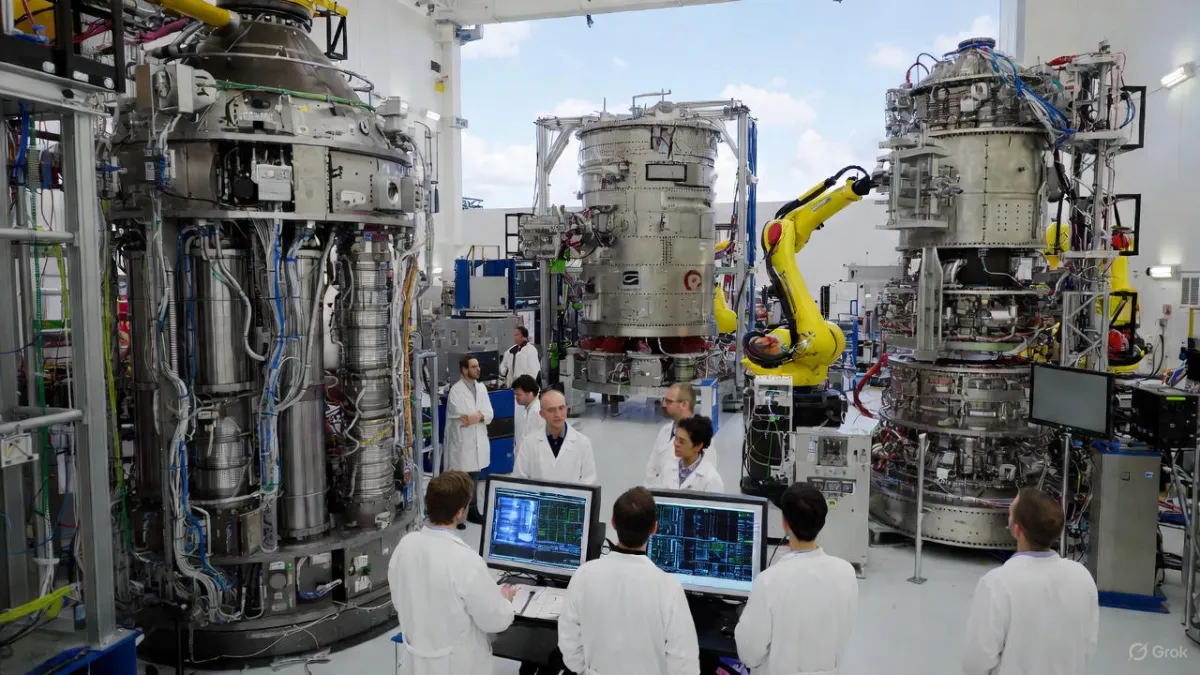
Fusion energy long considered the “holy grail” of clean power is no longer a distant scientific dream. Breakthroughs across private startups, national laboratories, and international research collaborations suggest that commercially viable fusion may be within reach earlier than expected. With major advances in confinement technologies, AI-optimized plasma control, and net-positive energy experiments, fusion is rapidly shifting from theoretical research to real-world engineering.
A Turning Point in Fusion Science
For decades, fusion struggled to produce more energy than it consumed. But over the last two years, multiple research teams achieved net energy gains, demonstrating that controlled fusion can surpass ignition thresholds under the right conditions. These validation milestones triggered a surge of investment, government interest, and infrastructure buildouts.
Facilities are transitioning from experimental reactors to prototype fusion power plants, systems designed not merely to prove physics, but to generate electricity at grid scale.
Breakthrough Technologies Driving Progress
Advanced Tokamaks and Magnetic Confinement
Modern tokamaks use high-temperature superconducting magnets to contain plasma more efficiently than traditional designs. These magnets require less power, withstand extreme conditions, and enable compact reactor architectures.
Inertial Confinement and Laser Advances
High-energy lasers can now deliver ultra-precise bursts that create fusion conditions inside fuel capsules. Recent upgrades improved symmetry, stability, and ignition efficiency.
AI-Enhanced Plasma Control
AI systems are becoming indispensable for stabilizing plasma, the superheated state required for sustained fusion. Machine-learning algorithms can predict turbulence and adjust magnetic fields in real time, enabling longer confinement times and more consistent output.
Breakthroughs in Fuel and Materials
Research into tritium breeding, advanced ceramic materials, and radiation-resistant alloys is solving one of fusion’s hardest barriers: building reactors that can operate continuously without structural degradation.
The Rise of Private Fusion Companies
Private fusion startups now outpace government research in both funding and prototype development. Organizations across the U.S., U.K., Japan, and Europe are racing to deploy demo reactors in the next decade.
These companies aim to deliver fusion systems that are:
- Compact
- Mass-manufacturable
- Cost-competitive with renewables
- Designed for rapid grid integration
Venture capital and sovereign wealth funds are pouring billions into the sector, signaling confidence that fusion will become a transformative global industry.
Environmental and Economic Impact
Fusion energy offers an unmatched sustainability profile:
- Zero carbon emissions during operation
- No long-lived radioactive waste
- Abundant fuel sourced from hydrogen isotopes
- Minimal land use compared to solar or wind
- Stable baseload power, unaffected by weather
If commercialized successfully, fusion would redefine global energy markets, strengthen grid reliability, and dramatically accelerate decarbonization.
Challenges Ahead
Despite progress, several hurdles remain:
- Scaling reactors for continuous operation
- Efficiently breeding tritium fuel
- Reducing development and operational costs
- Creating global fusion safety regulations
- Designing long-lasting materials for extreme environments
Experts warn that excitement must be balanced with realism, but the trajectory is undeniably shifting toward viability.
The Road to 2035
Most leading fusion developers target the early-to-mid 2030s for the first grid-connected fusion plants. If successful, commercialization could reshape geopolitics, energy independence, and climate strategies on a global scale.
Fusion energy is not merely an engineering challenge, it represents a fundamental leap in how humanity powers civilization. For the first time in history, that leap feels genuinely within reach.