 AJMNAssociated Journalism & Media Network
Quantum-safe encryption: why banks are changing their locks now
Quantum computers that can break today's encryption do not exist yet. Banks are preparing anyway, because data stolen now could be read later.
Banks, governments and technology companies are moving to quantum-safe encryption years before the threat they are defending against exists. Every time you open a banking app, send a payment or log in to a website, your data is protected by encryption. Most of it relies on mathematical problems, like factoring very large numbers, that ordinary computers cannot solve in any useful amount of time. A large, working quantum computer could solve some of them quickly, and that is the risk the industry is preparing for.
Harvest now, decrypt later
The reason is a strategy security experts call "harvest now, decrypt later". An attacker can copy encrypted data today, store it, and wait until quantum computers are good enough to unlock it. For a chat message that is not a big worry. For medical records, state secrets or long-term financial contracts that must stay private for twenty years, it is.
So the race is not to defend against quantum computers once they arrive. It is to switch before they arrive, because anything sent with the old methods in the meantime may one day be exposed.
The new standards
In August 2024 the US National Institute of Standards and Technology, NIST, published the first three post-quantum standards, known as FIPS 203, 204 and 205. They describe new methods for exchanging keys and signing data that are believed to resist attacks from both normal and quantum computers. NIST has also proposed, in draft guidance, that widely used older methods such as RSA and elliptic-curve cryptography be phased out from 2030 and disallowed from 2035.
Other authorities are setting similar goals. The European Union has pointed to 2030 as the target for protecting critical sectors, banking among them. In January 2026 the G7's group of financial cyber experts published a roadmap for the financial sector. In the United States, binding deadlines currently apply to federal agencies; for private banks, the pressure comes mainly from supervisors, partners and technology suppliers.
What the change involves
Switching is harder than it sounds. Large banks run thousands of systems, many of them decades old, and encryption is buried deep inside them, in payment networks, ATMs, card chips and links to other banks. The first job is simply finding out where encryption is used. Many institutions do not have a complete list.
The next step is what engineers call crypto-agility: building systems so that the encryption method can be swapped without rebuilding everything. Many organisations are starting with hybrid approaches that combine an old and a new method, so that a connection stays safe even if one of them turns out to have a weakness. Major web browsers and network providers already use hybrid key exchange for a large share of internet traffic.
What it means for customers
For most people the change will be invisible. Apps will update, cards will be replaced on their normal cycle, and websites will keep showing the same padlock. The work happens behind the scenes, and the institutions that start early will find it cheaper and less risky than those that wait for a deadline.
Security is becoming a major theme for investors as well as engineers. Read how Europe is adjusting its AI rules for another example of regulation shaping technology plans.
How close are quantum computers?
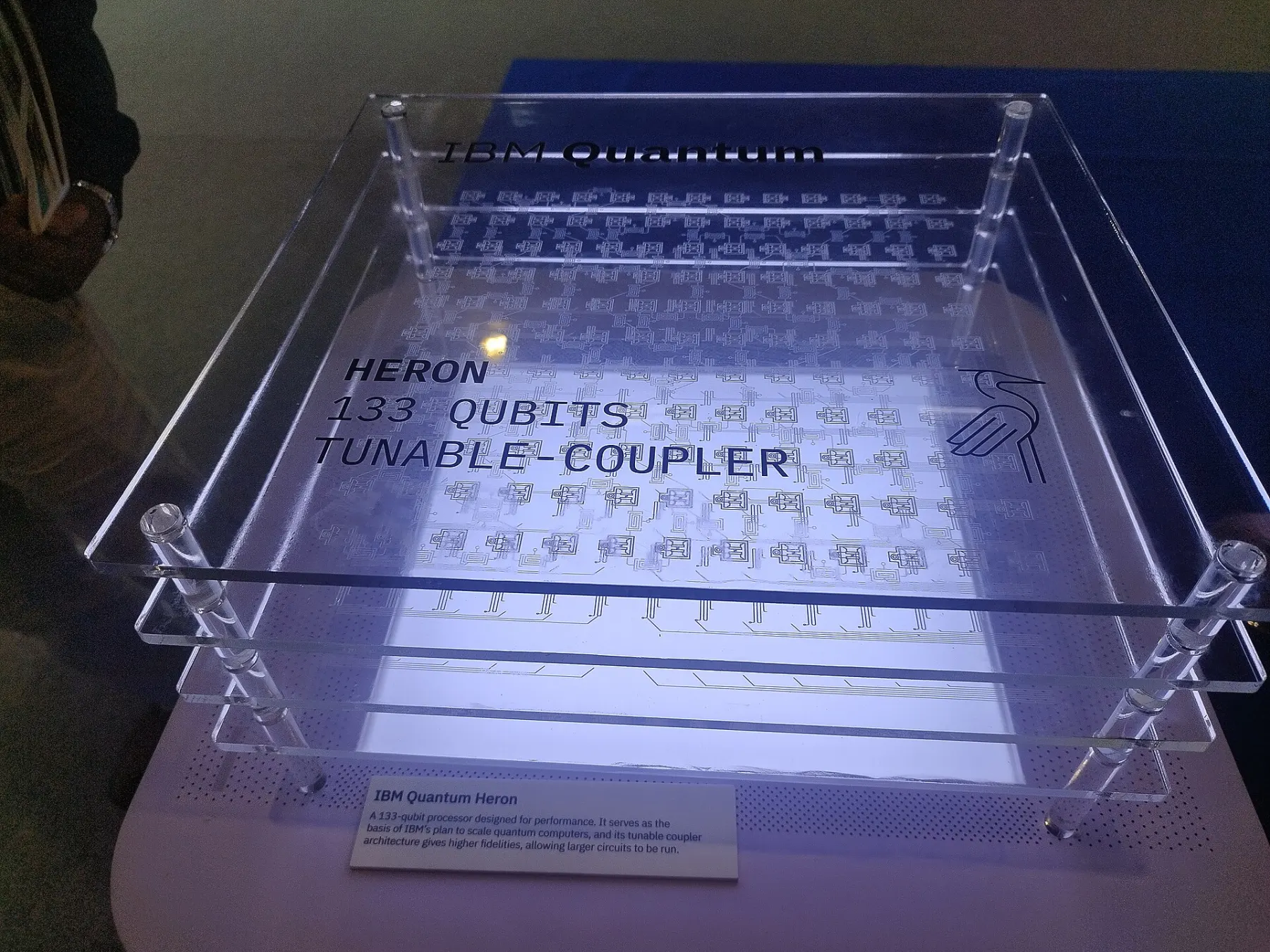
Nobody knows exactly. Today's quantum processors, like the IBM chip in the picture above, have grown from a handful of qubits to more than a hundred, but they still make too many errors to break real encryption. Experts disagree on whether a machine capable of it is ten years away or more than twenty. What they broadly agree on is that the switch to new encryption takes many years in a large organisation, which is why the work has to start long before the threat becomes real. For the investment side of the technology race, see how the Gulf is building AI computing capacity.
Sources: NIST post-quantum cryptography project; SecureWorld on the G7 roadmap; HSBC.